
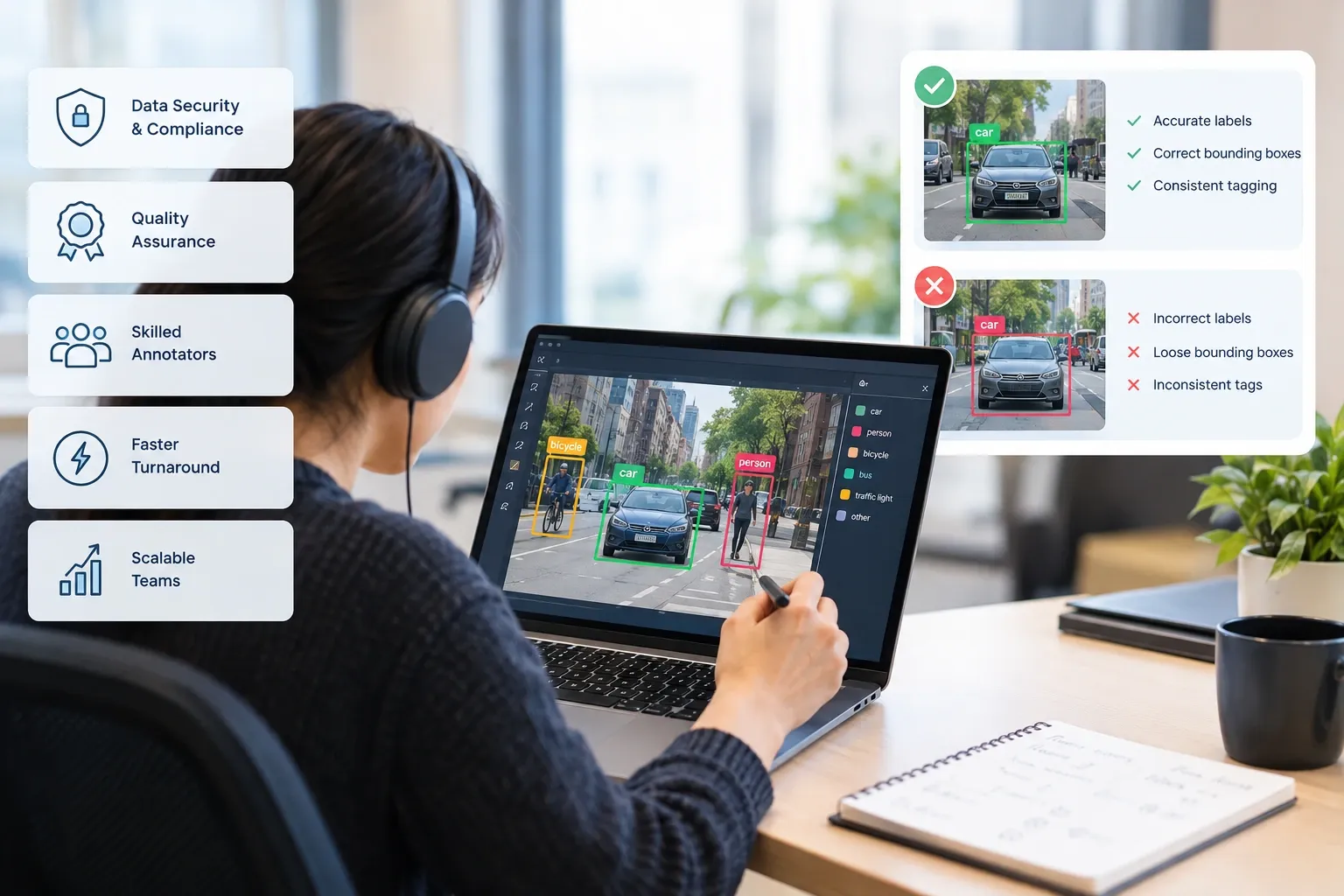
Your AI model is only as good as the data it learns from. When a labeled dataset has loose bounding boxes, incorrect classes, or inconsistent tags, you don’t just lose time; you lose confidence in the results your model produces.
That’s why choosing the right data annotation partner is an important decision for any AI team. Many companies work with annotation vendors to speed up the labeling process and let their engineers focus on building better models. But not every vendor follows the same standards. Some have secure, reliable, and well-managed workflows, while others may handle your data with less care and consistency.
The difference usually shows up too late, after the contract is signed and the first batch fails your quality check. Fixing bad labels costs far more than getting them right the first time, as we explain in The Hidden Cost of Poor Data Annotation Quality.
This guide provides 15 practical tips for gauging any vendor, questions to ask at your first meeting, and red flags to look out for that would cause you to turn around and run the other way.
Why Companies Outsource Data Annotation
Annotation is detailed, repetitive work, and the volume grows fast. A single computer vision project can need tens of thousands of labeled images, each reviewed more than once. When ML engineers spend their days drawing boxes, model development slows down.
Teams usually outsource for four reasons:
Scale: A vendor can put a trained team on your project in weeks, not months.
Cost: An offshore team typically costs less than hiring, training, and managing annotators in-house.
Speed: Parallel teams and shift coverage shorten turnaround times.
Expertise: Established vendors already have QA workflows, tool experience, and annotators trained on edge cases.
Still, outsourcing data annotation only pays off with the right partner. If you're new to the process, How Data Annotation Works: From Raw Data to Training-Ready Datasets walks through each stage.
In-House vs. Outsourced Annotation at a Glance
Neither option is right for every team. Many companies keep guideline design and final review in-house and outsource high-volume labeling.
The 15-Point Checklist for Choosing a Data Annotation Vendor
Use these criteria on every vendor call. Each point covers why it matters, what to ask, and what should worry you.
Data Security and Compliance
1. ISO 27001 certification
Certification means an independent auditor has verified the vendor's security controls. Ask: "Is your certificate current, and which body issued it?" Red flag: "We follow ISO standards" with no certificate to show. You can read what the standard covers on the ISO 27001 official page.
2. Privacy compliance (GDPR, HIPAA)
But compliance is a must if your data contains patient records, faces, or EU personal data. Request a data processing agreement (DPA) and ask how they manage PII and PHI. Red flag: If you get general answers about where your data is going, don't take them.
3. Secure infrastructure and access control
Look for restricted workstations, role-based access, VPN connections, and disabled downloads, and audit logs. Red flag: annotators working on personal laptops with no monitoring.
4. NDAs and data retention
Every annotator should sign an NDA. Ask what happens to your data when the project ends, and get the deletion policy in writing. See how we handle this on our Security and Compliance page.
Quality Assurance
5. Multi-layer QA
A strong workflow moves through annotation, peer review, QA lead review, and a final audit. Ask how many review layers each label passes through. Red flag: QA based only on random spot checks. Our How It Works page shows a multi-stage process in practice.
6. Measurable quality metrics
Request accuracy, IOU for bounding boxes and segmentation masks, inter-annotator accuracy, and class accuracy. Red flag: The vendor states "99% accuracy" but does not explain how and on what sample.
7. A pilot before commitment
A pilot of 500 to 1,000 samples shows you real output, real communication, and real turnaround. Red flag: a vendor that insists on a long-term contract with no trial.
Expertise and Capability
8. Domain expertise
Medical scans, satellite imagery, and insurance documents need annotators who understand the subject. A radiology dataset labeled by generalists will miss subtle findings. Ask for examples from your industry, like this medical AI annotation case study.
9. Annotation type coverage
Ensure that the vendor is capable of providing the required component of your project, as well as future components such as bounding boxes, polygons, semantic segmentation, keypoints, named entity recognition, sentiment, or audio transcription. Do the same with computer vision and NLP.
10. Tool flexibility
A good vendor works in your tool, whether that's CVAT, Labelbox, Voxel51, Dataloop, or V7 Darwin. Red flag: being pushed onto a proprietary platform that makes switching difficult. For a comparison of options, see Best 20 Data Labeling Tools for Every Data Company.
11. Workforce model
Ask whether annotators are full-time employees or an anonymous crowd. Trained in-house teams produce more consistent labels and are easier to secure, which matters in human-in-the-loop workflows.
Operations and Delivery
12. Scalability
If our volume doubles next month, how fast can you add 20 annotators? Then ask how new annotators are trained. Red flag: quality drops every time the team grows.
13. Turnaround time and SLAs
Get delivery timelines, quality thresholds, and rework terms in writing. Ask what happens when a batch fails your quality check. The right answer is fast rework at no extra cost.
14. Project management and communication
A separate project manager is required, regular reporting is needed, a clear escalation path is required, and there must be some overlap in working hours with your team. The red flag is when your only dealings are with a salesperson.
Commercial Fit
15. Transparent pricing and a proven track record
Pricing should follow a clear model: per label, per hour, or per dedicated team member. Watch for hidden charges on QA, rework, or tool setup. Then ask for case studies and references you can actually contact.
Red Flags That Should Stop the Deal
If you see any of these, keep looking:
No valid security certification
No pilot or trial option
A crowdsourced-only workforce for sensitive data
Accuracy claims with no measurement method
No written SLA or rework policy
Pricing that changes once the project starts
How to Run a Vendor Pilot That Shows Real Quality
A pilot is the fastest way to test a vendor's claims, but only if you set it up properly. These steps make the results reliable:
Use a representative sample. Include easy cases, hard cases, and edge cases, such as blurry images, overlapping objects, or rare classes. A pilot on clean data tells you very little.
Share your full guidelines. Give the vendor the same instructions your real project will use, so you're testing their work, not their guesswork.
Create a small gold-standard set. Have your own team label 50 to 100 samples, then compare the vendor's output against them.
Measure, don't eyeball. Check accuracy, IoU, and error rates by class instead of scrolling through a few random images.
Test communication too. Notice how quickly the vendor asks clarifying questions, reports issues, and fixes rejected labels.
Pilot two or three vendors on the same data. Comparing results side by side makes the final decision much easier.
If a vendor performs well on your hardest samples and responds quickly to feedback, that's a strong sign they'll hold up at full scale.
How Logictive Solutions Meets These Criteria
We built our annotation service around these same standards, so here's how we measure up:
Security: ISO/IEC 27001:2022 certified.
Quality: Multi-layer QA with a 99% accuracy benchmark.
Tools: Hands-on experience with CVAT, Voxel51, Labelbox, VIA, Hasty, Dataloop, and Darwin.
Team: Trained in-house annotators in Nepal, with capacity that scales with your project.
Reach: Offices in the UK, USA, and Nepal.
Final Thoughts
Choosing an annotation vendor is really choosing how reliable your model will be. Use this checklist on every vendor call, compare your options honestly, and never skip the pilot. The right partner will welcome your questions, because good processes are easy to explain.
If you're planning a project and considering outsourcing data annotation, our team can run a pilot on a sample of your data so you can judge the quality for yourself. Book a free consultation and let's talk about what your model needs.
Frequently Asked Questions
How much does outsourcing data annotation cost?
Cost depends on annotation type, data complexity, volume, and QA depth. Simple bounding boxes cost far less than pixel-level segmentation or medical labeling. Most vendors price per label, per hour, or per dedicated team member, so request a quote based on a sample of your real data.
How long does a typical annotation project take?
A pilot often takes one to two weeks. Full projects can run from a few weeks to several months, depending on volume, complexity, and review layers. Vendors with a trained team ready can start much faster than those who hire for each project.
Is outsourcing data annotation secure?
It can be if the vendor holds ISO 27001 certification, signs NDAs and a DPA, restricts data access, and follows clear deletion policies. Security depends entirely on the vendor's controls, so verify them before sharing any real data.
What is the difference between a data annotation vendor and a crowdsourcing platform?
A managed vendor uses a trained, dedicated team with project management and multi-layer QA. Crowdsourcing platforms split tasks across many anonymous workers. Crowdsourcing can be cheaper for simple tasks, but managed teams offer better consistency, accountability, and security.
Should I run a pilot before choosing a vendor?
Yes. A pilot on a representative sample shows you label quality, communication, and turnaround before you commit. It also helps you refine annotation guidelines early, which prevents expensive rework later.
What accuracy should I expect from a professional annotation company?
Accuracy targets depend on the task and should be agreed upon in your SLA. Simple classification can reach very high accuracy, while complex segmentation or medical labeling needs tighter review. More important than the headline number is how the vendor measures it.