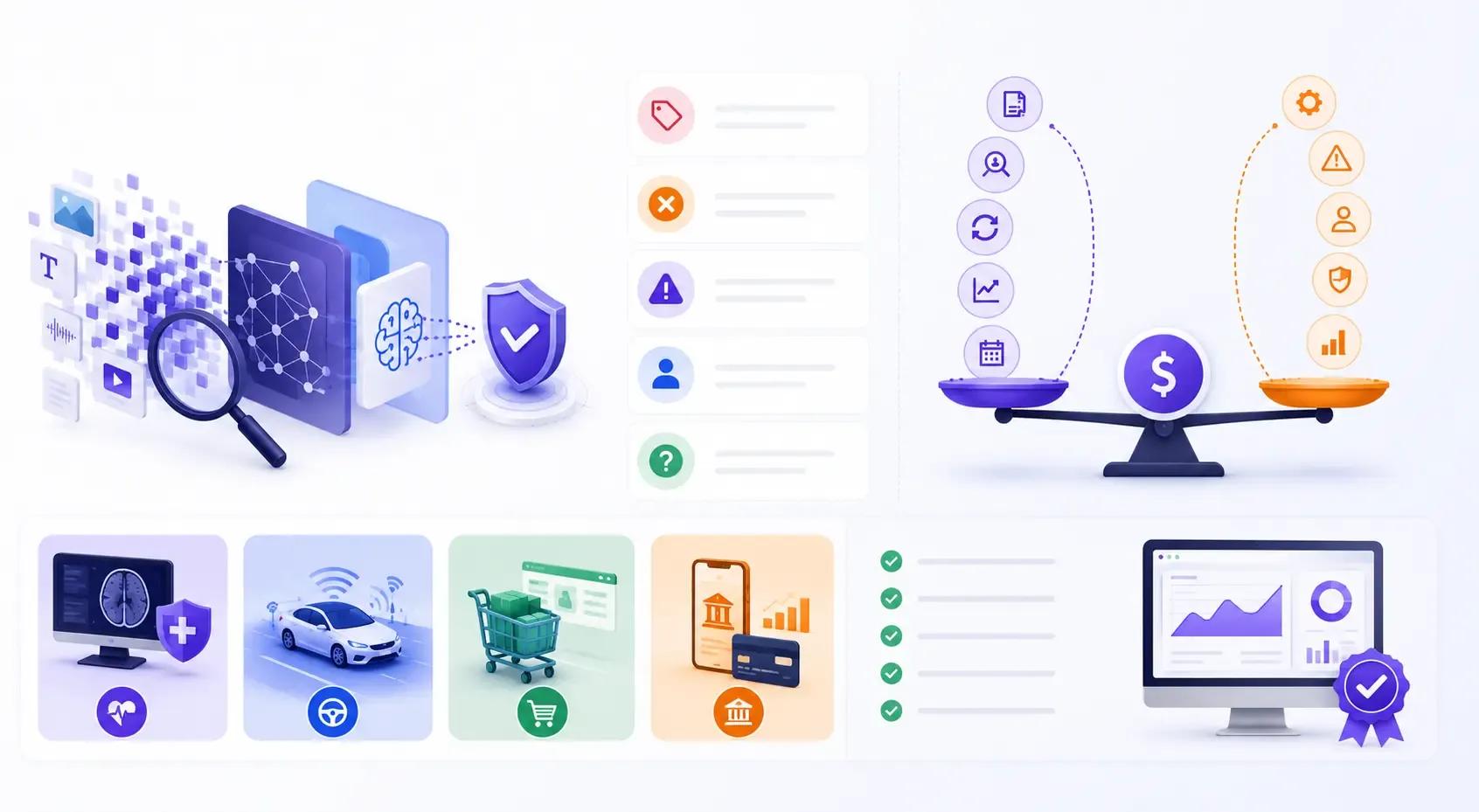
The demand for AI systems is growing at a rapid pace, particularly in the need to develop them quickly. To catch up, numerous teams are turning to automated labeling tools and AI-powered annotation platforms to speed up the process of dataset generation, minimize manual workload, and cut down on expenses.
These technologies help make things more efficient, but they also lead to a misconception that annotating the data well enough won't be a problem when the data is automated. In practice, many organizations find out the results when the deployment goes awry in real time. When their predictions are incorrect, deployments are delayed, and costly model retraining is experienced.
All AI models are limited by the data they are trained on. If data annotation is of poor quality, this will be incorporated into the model's learning algorithm and will creep into all of its predictions. A little problem while preparing the dataset can easily become a big problem for the business.
This article delves deeper into the effects of bad data annotation on the performance of AI systems, the hidden costs of bad data annotation, and how organizations can improve the quality of their data from the beginning.
What Is Data Annotation and Why Does Quality Matter?
Data annotation is the process of applying labels to raw data, which can include images, text, audio, video, or data from a sensor, to help machine learning systems identify patterns and make informed decisions. These annotations are the basis for all the predictions made by the AI system and are considered the ground truth for the model.
Therefore, annotation quality should not be seen as a mere preprocessing step. It has a direct impact on model performance, consistency, and business performance. Mistakes in labeling, no matter how minor, can create bias, decrease prediction accuracy, and limit the reliability of AI systems in real-world applications.
"The best AI teams learned it early: you don't improve the model first, you improve the data. Quality annotation is the foundation everything reliable is built on."
The quality of data annotations is poor when they are incorrect, inconsistent, incomplete, or developed without the needed domain knowledge. The model is taught incorrect patterns that have a lasting impact on the performance even after deployment.
Companies that have consistently developed effective AI solutions know that the first step in enhancing the performance of an AI model is to enhance the quality of the data. The investment in high-quality annotation, labeling standards, and quality assurance provides a solid base for achieving reliable AI results while minimizing rework, which can be time- and resource-intensive.
The Rush Toward Automation: Where It Goes Wrong
Today's annotation platforms provide features such as auto-labelling, model-assisted annotation, and pre-trained AI, which truly speed up the annotation process. When used properly, these tools are very useful.
The issue is that organizations see automation as a replacement for human expertise instead of a way to improve their productivity. When this occurs, teams usually have the following: organizations label data faster and speed up the entire development process. The guarantees are clear: quicker turnaround, reduced cost, and reduced manual labor. The truth is that most teams find out about poor data annotation quality only after deployment, and the loss of investment funds, project time, and the weakening of the models that your business relies on are all but unseen.
The quality of the data impacts the quality of the AI model. If the annotation is rushed or not sufficiently validated, errors are incorporated in all the predictions that the model can make, often hidden until production runs amok.
This article decodes exactly where the expenses of poor information annotation quality are coming from, what they amount to, and what your team can do to avoid them in the beginning.
- Inconsistent labels across the dataset
- Incorrect annotations that directly mislead the model
- Missed edge cases, the rare scenarios where accuracy matters most
- Domain-specific errors that only a subject matter expert would catch
- Ambiguous cases are left unresolved rather than reasoned through
The result is poor model performance, costly rework, and delayed deployment, the opposite of what automation was supposed to deliver.
The Real Cost of Poor Data Annotation Quality
The financial impact of poor data annotation quality extends well beyond the cost of correcting a few labels. Organizations typically encounter two layers of cost, one visible and one not.
Direct Costs: The Visible Damage
These appear as concrete project expenses once errors are discovered:
• Re-labeling large portions of the dataset
• Additional quality assurance review cycles
• Retraining machine learning models on corrected data
• Re-running validation and benchmark testing
• Delayed deployment timelines and missed product milestones
Hidden Costs: The Larger Problem
These are harder to see on a budget sheet but often more damaging in practice:
- Engineering time diverted from new development to cleanup work
- Business decisions are made on inaccurate model outputs before errors are caught
- Customer dissatisfaction caused by unreliable AI-driven features
- Regulatory and compliance risks in sensitive industries
- Lost competitive advantage as projects fall behind schedule
These indirect costs are not usually presented as a single cost, hence why they are often underestimated when they do not exist until they have already accumulated.
Why AI Projects Really Fail: Industry Examples
Many organizations think that the more powerful the model, the better it will work. However, in the real world and the data that powers AI, the same has emerged: Data quality matters much more than model selection.
Even the best algorithms cannot overcome poor training labels. Therefore, the following situations arise in various industries:
Healthcare:
Medical imaging and clinical AI require highly specialized annotation. Small labeling errors in diagnostic datasets can affect model accuracy and ultimately influence patient outcomes. Automated tools often miss the subtle clinical nuances that trained reviewers catch.
Agriculture:
The identification of crop varieties, plant diseases, and field conditions requires expert knowledge. A model developed with generic vegetation classifications cannot capture the differences that are important for agronomists.
Autonomous Vehicles:
In all weather conditions, accurately labeled images, LiDAR, and video data are needed for self-driving systems. Errors made in unusual weather or lighting conditions or building work are just the sorts of cases that automation is likely to get wrong: hazardous safety issues.
Insurance:
Claims and underwriting information can be unstructured and inconsequential and may date back many years. Expert review with accurate annotation leads to better compliance, processing in large volumes, and better model reliability.
The pattern is consistent: automation handles common cases well. The edge cases where accuracy is most critical require human expertise.
Why Prevention Costs Far Less Than Rework
One of the most expensive mistakes organizations make is discovering annotation problems only after model training has begun. At that stage, correcting the issue requires far more than fixing labels. Teams typically need to
- Rebuild annotation guidelines from scratch
- Re-label large portions of the dataset
- Run additional quality reviews across updated data
- Retrain models often from an earlier checkpoint or from scratch
- Repeat validation and benchmark testing
- Absorb delayed production releases and downstream business impact
What initially appeared to be a cost-saving shortcut becomes an expensive cycle of rework. In many cases, organizations end up hiring human annotators to fix the dataset anyway; only now they are correcting a flawed foundation rather than building a clean one.
Investing in poor data annotation quality prevention from the beginning is almost always more economical than repairing it after the fact.
Rewriting this sentence, the intent here is that investing in quality upfront prevents the costs of poor annotation. Suggest revising to: "Prioritizing annotation quality from day one consistently costs less than repairing a flawed dataset later."
Best Practices for High-Quality Data Annotation
Organizations that consistently build reliable AI systems follow a similar set of principles:
- Spend well on the early part. The cost of a clean dataset, built right, is far less than the cost of a corrected one.
- Responsibly use AI-assisted annotation with human validation for all critical datasets.
- Invite subject matter experts for niche specialties like healthcare, agriculture, finance, insurance, and the like.
- Implement quality assurance in the annotation process from the beginning and not only at the end.
- Verify human oversight to catch errors that are not apparent to automation.
- Create shared and agreed-upon guidelines for annotators to minimize ambiguity within and across annotators and datasets.
- These practices help minimize labeling inaccuracies and enhance the accuracy, reliability, and scalability of the models.
conclusion
As AI becomes increasingly accessible, competitive advantage no longer depends solely on powerful algorithms or larger computing resources. It depends on the quality of the data behind those systems. Poor data annotation quality introduces hidden risks that lead to inaccurate predictions, delayed deployments, compliance challenges, and unnecessary project costs.
Organizations that prioritize expert annotation, rigorous quality assurance, and human validation build AI solutions that are more reliable, trustworthy, and ready for real-world use.
In AI, moving fast matters, but building on accurate data is what delivers lasting results.
Concerned About Annotation Quality in Your AI Project?
Logictive Solutions helps organizations build accurate, scalable training datasets through AI-assisted workflows, experienced annotators, subject matter experts, and rigorous multilayer quality assurance so your models perform reliably in production, not just in testing.
Get in touch: hello@logictive.solutions
Learn more about data annotation service in Nepal