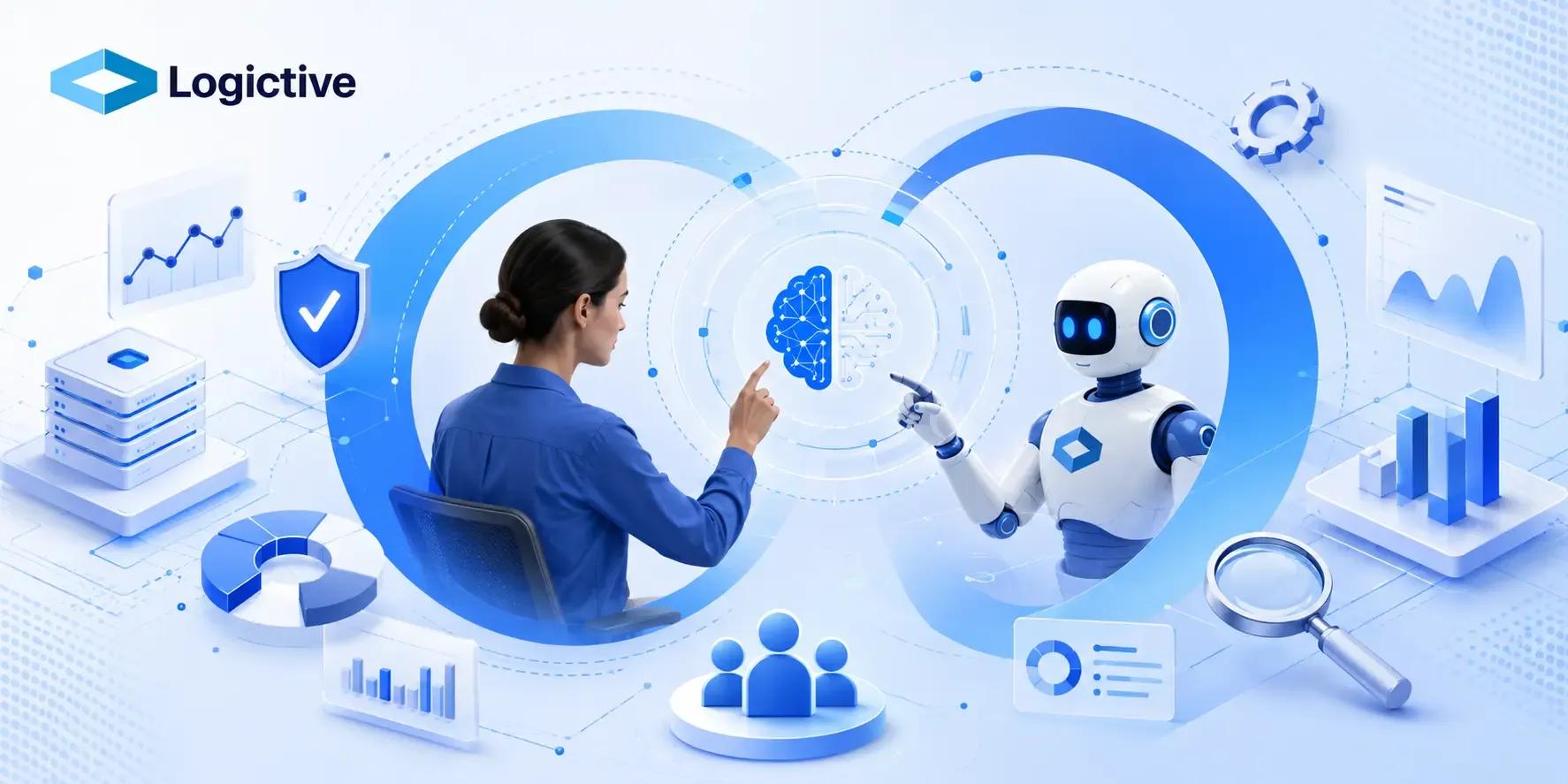
Why Humans Still Matter in Machine Learning
Industries have been revolutionized by artificial intelligence in a way that has never been seen before. AI is enabling businesses to streamline operations, save money, and boost efficiency in several use cases, including in the fields of transportation, medical imaging, and customer service chatbots.
This is because, as these systems grow more capable, it is an easy leap to think: Do we need people in the middle of all of this?
Research on many AI applications in the real world has led to an unequivocal answer: yes.
Automation can control the speed and scale, but human oversight is essential in keeping AI accurate, safe, and reliable. That's why, in certain industries where precision and dependability are crucial, human-in-the-loop AI has emerged as a pivotal element in contemporary machine learning frameworks.
The article delves into how humans still outperform machines in machine learning, why it is important, and how human-in-the-loop AI can help organizations create accurate, reliable, and trustworthy AI models.
What Is Human-in-the-Loop AI?
Human in the loop (HITL) is a philosophy where human people not only participate in the machine learning process, but they are also a part of the machine learning process.
Human-in-the-loop AI is not either-or; it's both. Automation is speed and scale; humans are validation, context, quality, and decision-making.
During a typical Human-in-the-Loop AI workflow:
✔️ The initial annotations are created with the help of AI-assisted tools.
✔️ Human annotators correct and review predictions.
✔️ Ambiguous cases are settled by subject matter experts.
✔️ Quality assurance groups check consistency.
Student feedback is collected and used for further enhancement of the future models.
This forms an iterative process that enables humans and machines to complement each other, leading to the generation of higher-quality training data and more precise machine learning models.
Why AI Still Needs Human Judgment
Modern AI models are remarkably powerful, but they are not infallible. Their limitations become particularly apparent in situations that require reasoning, interpretation, and contextual understanding.
Understanding Context
Machines identify patterns. Humans understand meaning.
One image, document, or sentence can have more than one interpretation, which relies on the context. These can be problematic for AI and are easily picked up by humans.
An example is that an image recognition model can identify the objects accurately but not understand their relations in a given context.
Handling Ambiguity
Real-world data is rarely perfect.
Images can be blurry. Documents can be incomplete. Audio files may contain background noise. Words can be ambiguous and nebulous.
AI systems can predict under uncertainty; they can predict "probabilities." Humans have the ability to reason and make decisions to determine what is most likely the correct interpretation.
Managing Rare Events and Edge Cases
Machine learning models work best on patterns that they have encountered several times in the training process.
But, in the real world, there are always some weird things going on.
Automated systems face challenges from unusual weather conditions, rare medical requirements, damaged documents, and unusual customer requests, just to name a few. Human reviewers take up the task of dealing with these edge cases, which helps to resolve the issue, thereby not affecting the performance of the models.
Applying Domain-Specific Expertise
Certain decisions require specialized knowledge that general-purpose AI models simply do not possess.
- Medical imaging requires clinical expertise.
- Agricultural AI requires agronomic knowledge.
- Legal document classification requires legal understanding.
- Insurance data processing requires industry-specific experience.
In these situations, subject matter experts provide insights that significantly improve annotation quality and model accuracy.
Why Subject Matter Expertise Is Essential
One of the most overlooked aspects of AI development is the importance of domain knowledge.
A generic annotator or automated tool may identify objects, but understanding what those objects represent often requires specialized expertise.
For example:
✔️ A medical reviewer understands anatomical structures and pathology.
✔️ A botanist understands plant taxonomy and species differences.
✔️ A geospatial analyst understands land-use patterns and remote sensing imagery.
✔️ A legal reviewer understands contractual language and document classification.
Without this expertise, annotations may appear correct on the surface while containing significant errors that affect model performance.
This creates a dangerous illusion of quality data that looks complete but quietly introduces inaccuracies into every model trained on it.
The Human Roles Behind High-Quality AI Systems
Successful AI projects rely on more than a single annotator.
High-quality datasets are typically created through multiple layers of human review and validation.
Annotators
Annotators create and refine the labels that machine learning models use during training.
Subject Matter Experts (SMEs)
SMEs resolve complex, ambiguous, or domain-specific cases that require specialized knowledge.
Quality Assurance Teams
QA reviewers identify inconsistencies, validate guidelines, and ensure dataset quality before deployment.
Validators and Reviewers
Validators provide final approval and ensure outputs meet project requirements.
Together, these roles form the "loop" in Human-in-the-Loop AI and help maintain accuracy throughout the machine learning lifecycle.
Why This Market Is Growing Fast
The need for AI that does things with humans has not diminished; It's growing rapidly
According to the global AI annotation market report done by Market Us, the global AI annotation industry witnessed USD 2.3 billion in revenue in 2024 and is expected to expand at a CAGR of 28.60%, reaching USD 28.5 billion by 2034.
The important issue is what is causing this number, and what is the motive? Manual annotations still hold the top spot at 63.8% of the market in 2024, even with the progress made in automation, with high-stakes applications such as medical imaging, automotive, and legal text analysis, where the risk of error is too great. AWS Builder Center
Automation is improving. But the industries that need AI most are also the ones that cannot afford to get it wrong. That tension is exactly why human oversight remains essential.
Human In The Loop in Practice: Where It Matters Across Industries
Medical Imaging and Healthcare AI
An automated system may detect anatomical structures but miss the subtle deviations that indicate a problem. A trained clinical reviewer catches what the model overlooks, and in a diagnostic AI context, that directly affects patient outcomes.
Logictive Solutions has delivered annotation work for fetal ultrasound AI and body composition analysis tools, building labeled datasets that require both clinical accuracy and multi-layered QA. You can read more in our Fetal Ultrasound AI case study.
Agri-Tech and Drone Imagery Segmentation
However, general vegetation data is not well-suited to agriculture because AI systems lack the nuance needed to distinguish among weeds and early detection of diseases or other concerns. If the image semantic segmentation is to be accurate, the annotators must be knowledgeable about the content of the images they are annotating.
Logictive's agri-tech work, including the AG Tech crop management project, demonstrates how domain knowledge translates directly into model performance in real field conditions. See the AG Tech case study.
Autonomous Vehicles and 3D Point Cloud Labeling
Autonomous vehicles account for roughly 32.9% of the annotation market in 2024, driven by demand for high-fidelity training data, including frame-by-frame labeling of images, LiDAR feeds, and radar data. Market.us
AI-assisted tools handle standard highway scenarios well. They struggle in unusual weather, poor lighting, and complex construction zones, exactly the edge cases where spatial accuracy is most critical. Human reviewers provide the oversight that keeps safety-critical datasets reliable.
Insurance Data Migration
Insurance is one of the clearest examples of where removing humans from the process creates serious risk.
In 2024, 77% of insurance carriers launched major AI initiatives across underwriting, claims, and operational functions. Yet only around 7% are likely to move beyond pilot programs, with trust, accuracy, and the chaotic reality of insurance data cited as the primary barriers. FinTech Global
Legacy insurance records span decades. These have inconsistent formats and incomplete fields and policies, which can only be interpreted correctly by experienced data specialists. The quality of output from AI models depends on the quality of the data they are trained with, and even powerful AI can be wrong when there is incomplete, unstructured data. With human intervention involved, insurers can have a closed-loop process, which can enhance the performance of the system and adjust it to match real-world needs. Roots
Logictive Solutions works with insurance companies to migrate policy, claims, and underwriting data from legacy systems with zero data loss and 99% accuracy. Human oversight is built into every stage of the process. Learn more about our Insurance Data Migration service.
Pure Automation vs. Human-in-the-Loop AI
While automation delivers speed, human-in-the-loop AI delivers reliability. For high-stakes applications, reliability is often far more valuable than speed alone.
The Cost of Removing Humans from the Loop
Many organizations are interested in automation for cost savings and/or the rapid deployment of AI.
Eliminating humans from the mix, however, can introduce issues that may be far more costly to correct later on.
One popular case in point is the use of AI technology for drive-thrus that misorder orders after years of growth and investment. One popular example is the AI-powered drive-thrus that misorder customer orders after years of investment and development. The technology experienced poor performance on accents, environmental noise, contextual understanding, and real-world variability.
The lesson is simple:
When it comes to AI, it's no different; the more data it has to work with and the more human oversight it receives, the better it will perform.
Data quality issues are a recurring problem in AI project failures, as reported in various industry studies.
A focus on speed and not quality often results in the following:
- Reduced model accuracy
- Costly retraining efforts
- Operational disruptions
- Compliance risks
- Loss of customer trust
- Delayed project timelines
The financial consequences can be substantial.
An inaccurate model after deployment typically will require data scrubbing, data labeling, model retraining, output revalidation, and redevelopment.
It can be much more expensive to implement it later than to have the quality controls in place from the outset.
Cleaning up is invariably more expensive than prevention.
These failures most often start on the ground and fail to result from the model per se.
They tend to begin much earlier without adequate annotations, labels, a review process, and a lack of human oversight.
To learn more about the accumulation of annotation errors leading to technical debt, higher costs, and modeling problems, read our next article:
Conclusion
Temporary human in the loop until automation is better.
It's an accepted process for creating good-quality AI systems that can perform effectively in the real world.
Automation provides speed. Judgment is given by man. These two go hand in hand to build the backbone of a successful machine learning project.
As AI becomes more prevalent in healthcare, agriculture, autonomous systems, insurance, and beyond, organizations that continue to invest in human oversight will continue to flourish over automation.
AI models are only effective when they are based on high-quality data. Behind every great dataset is people's expertise. When organizations are moving towards an ever-faster pace of automation, it's not just about creating smarter models. It's making sure the data they're learning is accurate, consistent, and trusted.
Continue Reading: The Hidden Cost of Poor Data Annotation