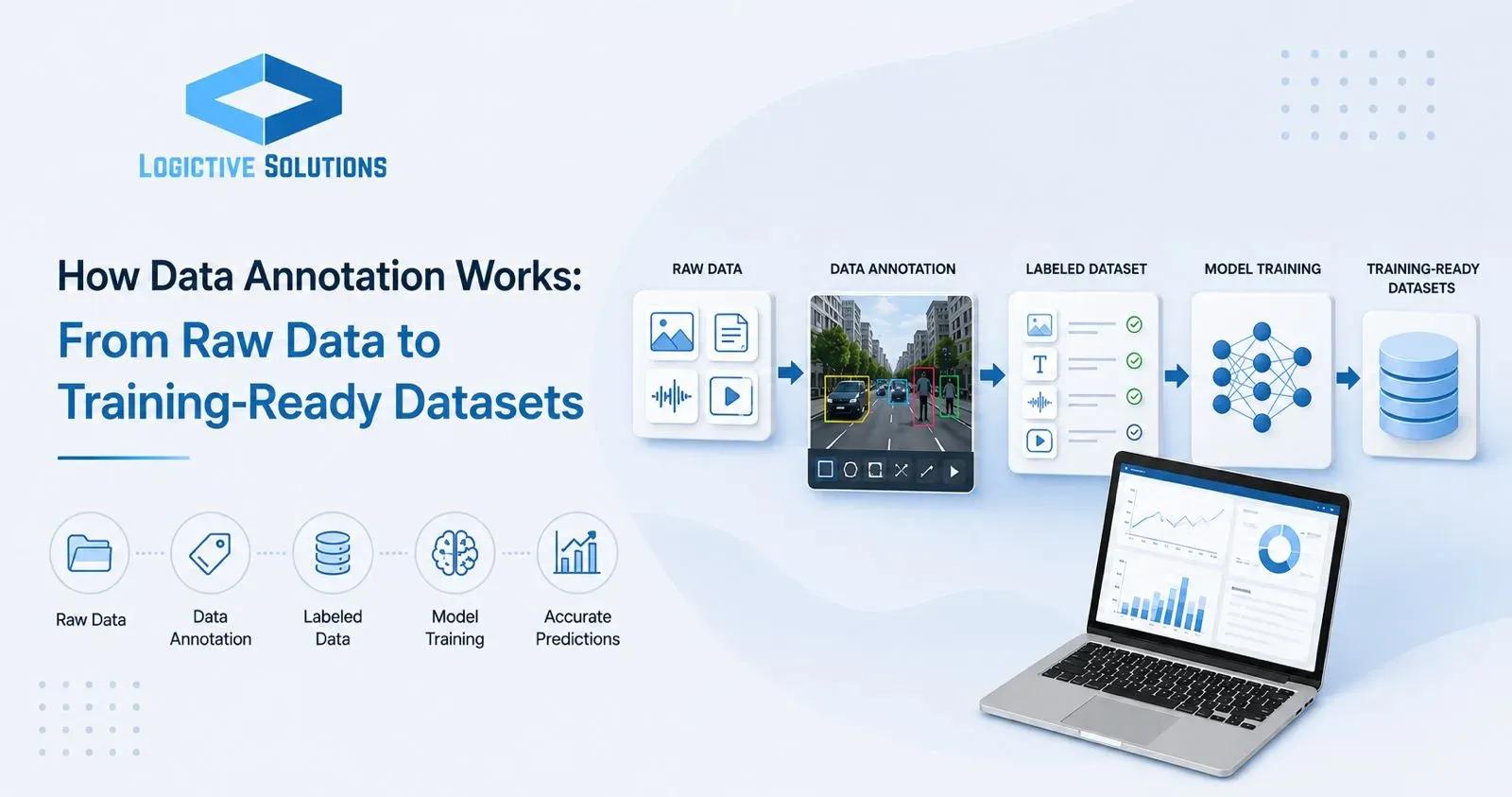
Many people think building a successful AI model is all about choosing the right algorithm. But in most cases, the real challenge is creating high-quality training data. Accurate data annotation is what enables AI models to learn and make reliable predictions.
Data annotation is the process of assigning labels to raw data, such as images, text, audio, or video, enabling machine learning models to derive meaning and learn from it. Labels can range from drawing a bounding box around a car to labeling a customer review's sentiment to labelling the speaker in an audio recording, all of which help teach the AI model what to recognize.
The performance of the models is directly affected by the quality of these labels. Even the most advanced AI model can result in incorrect outcomes if there is a lack of consistency and accuracy in the annotations. It is advantageous to have a smaller, well-labeled data set rather than a large, poorly labelled one.
In this article, you will learn what data annotation is, why it's important for quality assurance, the different kinds of data annotation for computer vision, natural language processing (NLP), and audio artificial intelligence (AI), and the tools that AI teams use for quality assurance. It also provides best practices for quality assurance and guidelines for choosing the appropriate data annotation partner for your project.
What is Data Annotation?
Data annotation refers to the process of making annotations, or tags, for the raw data, which can be images, text, voice, or video, that help artificial intelligence models to learn from the data. They would be of little value if they were not organized into labels. For instance, a picture of a street might consist of a collection of pixels, which can only be given meaning by someone who can recognize the various objects such as people, cars, and traffic signs. The labels give the model information to use when determining the meaning of each object and also aid the model in predicting what it will see in a true world.
Three core ideas help explain how data annotation works:
Supervised learning: Models are trained using patterns in which the response is provided to them.
Labelled datasets: The output is training, validation, and test sets labelled.
Human in the loop: Labels require special training; they have to be checked, corrected, and approved by trained individuals, particularly in unusual circumstances where they cannot be automatically generated
High-quality data annotation is now a key part of building AI solutions in industries like:
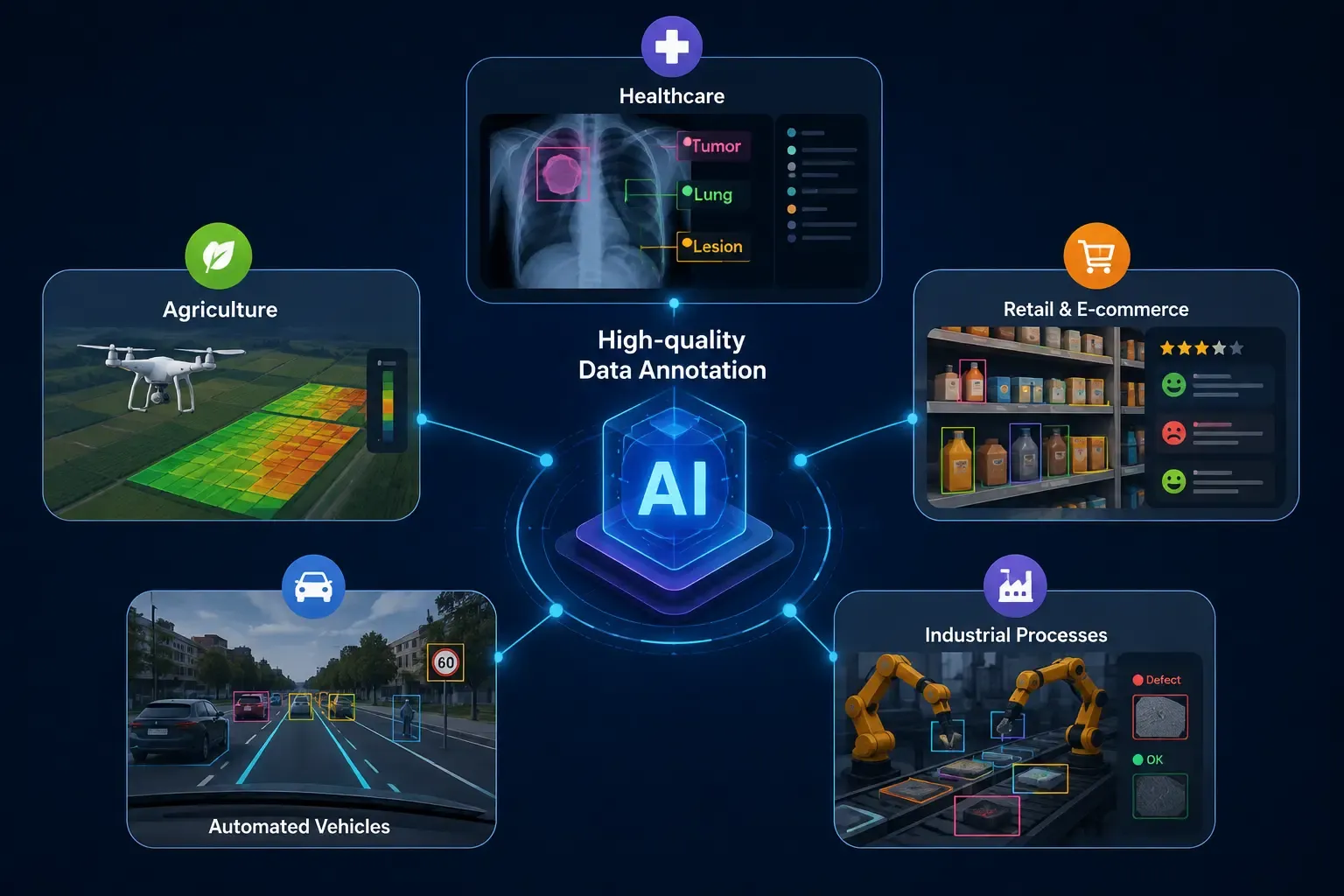
Healthcare: Annotating medical images to identify tumors, organs, lesions, and other abnormalities, helping AI support faster and more accurate diagnoses.
Agriculture: Disease Detection, Weed Management via Drone, Yield Indices.
Retail & E-commerce: Annotating product images, shelf displays, and customer reviews to power product recognition, inventory management, and sentiment analysis.
Automated vehicles: lane markings, traffic signs, pedestrian detection, and recognition of 3D objects.
Industrial processes: surface defects and safety checks.
Without accurate annotations, even the most advanced AI models struggle to make reliable predictions.
Why Annotation Quality Matters
The maxim in machine learning is “garbage in, garbage out,” or GIGO. Even the best AI models won't perform well without the best data it can learn from. The model will have incorrect results if it is mistrained or it is inconsistently labeled.
Every AI model is built on a simple but essential workflow:
Raw Data → Data Annotation → Training Dataset → Machine Learning Model → Predictions
Each step relies on the previous step. Weak annotation at any point in the process will impact each subsequent step.
Poor annotation quality can lead to several challenges:
Model Input Inconsistencies: Model errors may arise from model inputs from multiple annotators being inconsistent.
Less accuracy: There may be false positives, meaning that the model recognizes entities/elements where they don't actually exist.
This lack of detailed annotations can have serious consequences in industries like healthcare, manufacturing, and autonomous driving, where the model is not able to detect key objects/actors/uses.
Bias in AI models: Some information, environments, or groups of users may be missing or be retrieved differently, causing the model to make biased predictions.
More expensive to correct: Making mistakes in the annotations once the models have been trained is more resource-intensive and expensive than establishing good annotation guidelines beforehand.
If you want good annotations, then it's not simply a matter of stringing one on to the end of the project. It is a continuous process, including clear instructions, trained annotators, and regular quality control and feedback throughout the data labeling process.
The better your annotations, the better your training data, and ultimately, the more accurate and reliable your AI model will be.
Types of Data Annotation
Methods differ by data type and by what the model needs to learn. These are the categories teams work with most often.
Computer Vision Annotation
Computer vision annotation teaches models to interpret visual information. The technique you choose depends on how precisely the model must understand shape and position.
Bounding Boxes: rectangles drawn around objects. Fast and cost-effective, used for object detection in retail shelves, traffic monitoring, and security footage.
Polygon Annotation: Point-by-point outlines used to follow nonpolygon shapes. Usually seen in aerial photography, crop divisions, and rooftop/solar panel detection.
Semantic Segmentation: Each pixel is classified, for example, with a class "road", "sky," or "vegetation." Autonomous control in driving, satellite analysis.
Instance Segmentation: This is similar to semantic segmentation, but each instance of an object is segmented so that the frame in which 10 people are present becomes 10 separate instances.
Typically used for pose estimation, sports analytics, and physiotherapy applications, keypoint annotation refers to marking specific points like joints or facial landmarks.
Cuboids (3D): Modeling three-dimensional boxes that additionally account for depth and orientation, vital for datasets like LiDAR and datasets for autonomous vehicles. Cuboids are 3D boxes that also include depth and orientation, which is essential for datasets such as LiDAR and autonomous vehicle datasets.
Image classification is used when a classification is given to an entire image, which can be used for defect pass or fail testing, and in content sorting applications.
OCR Annotation: annotation and transcription of text within images, such as in document digitization and invoices as well as insurance documents.
Read more: Computer Vision Annotation
NLP Annotation
Natural language processing annotation teaches models to interpret meaning, intent, and structure in text. It demands linguistic judgment rather than visual precision.
Document Classification: categorizing documents into topics, priority, department, or other categories.
Named Entity Recognition (NER): Labeling of locations, medications, dates and organizations within free text.
Sentiment Analysis: Tagging the sentiment as positive, negative, neutral, or mixed.
Intent Classification: Defining the intent behind a person's request for a bot or voice assistant.
POS Tagging: Labeling parts of speech like noun, verb, and adjective.
Entity Linking: When a mention is related to a particular record on a knowledge base, as in the case of Apple getting resolved to the company and not the fruit.
Question-Answer Annotation: a process of matching questions to appropriate passages to help the retrieval and generative systems.
Read more: Natural Language Processing Annotation
Audio Annotation
Audio annotation converts sound into structured, machine-readable data.
Speech Transcription: converting spoken words into accurate text.
Speaker Diarization: identifying who spoke and when across a recording.
Emotion Detection: labeling tone and emotional state in voice data.
Keyword Spotting: Tagging wake words and trigger phrases.
Audio Event Detection: marking non-speech sounds such as alarms, machinery faults, or glass breaking.
Computer Vision vs NLP Annotation
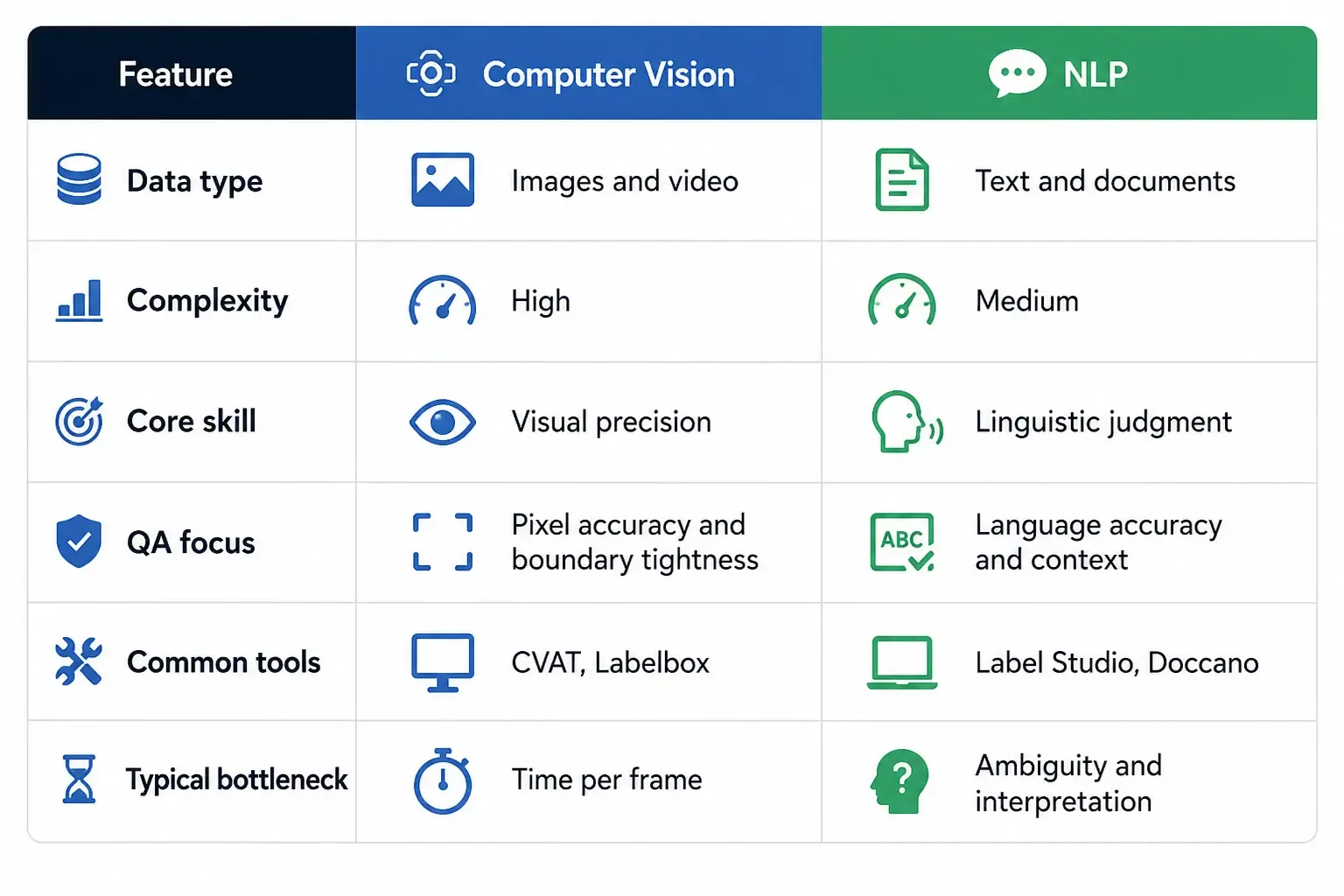
You can learn more about computer vision vs. NLP Annotation in next blog
Choosing Annotation Tools
A good tool should diminish friction, not increase it. Consider features like support for your data type, keyboard workflow, automatic QA and review stages, role-based access control, model-assisted pre-labeling, and clean export formats like COCO, YOLO, or JSON.
Open source options
CVAT: strong for image and video labeling at scale.
Label Studio: flexible across text, image, and audio.
LabelMe: lightweight polygon and segmentation labeling.
Doccano: purpose-built for text and NLP tasks.
Commercial platforms
Labelbox, SuperAnnotate, Encord, V7, and Scale AI: These add workflow automation, analytics dashboards, model-assisted labelling, and enterprise governance features.
Data curation platforms
Artifacts like Voxel51, Dataloop, and Hasty emphasize the cycle that surrounds the labeling part, like versioning at the dataset level, searching for failures, revealing mislabeled samples, and using model output as input to the dataset. This layer may be more important than the labelling interface for frequent retraining teams.
Best Practices for Annotation Quality
Accuracy comes from process discipline, not from hiring more annotators.
Be explicit: specify each class and provide examples, including visual examples, and explain how to deal with cases of occlusion, blur, and ambiguity.
Weeks of rework can be avoided through the simple step of training annotators before production.
Identify gold standard labels: a small and expert-verified set that measures annotator accuracy in an objective way.
Use consensus review: multiple annotators annotate the same sample and disambiguate differences.
Monitor inter-annotator consensus; don't blame the annotators for unclear guidelines if it's low.
Check samples for QA regularly – review instead of end-of-batch auditing.
A close loop of feedback, with corrections sent to the annotators in a timely fashion, preventing their recurrence.
Quality checklist
Clear, versioned instructions
Multi-layer QA review
Random batch sampling
Fast, documented feedback loop
In-house vs Outsourced vs Hybrid
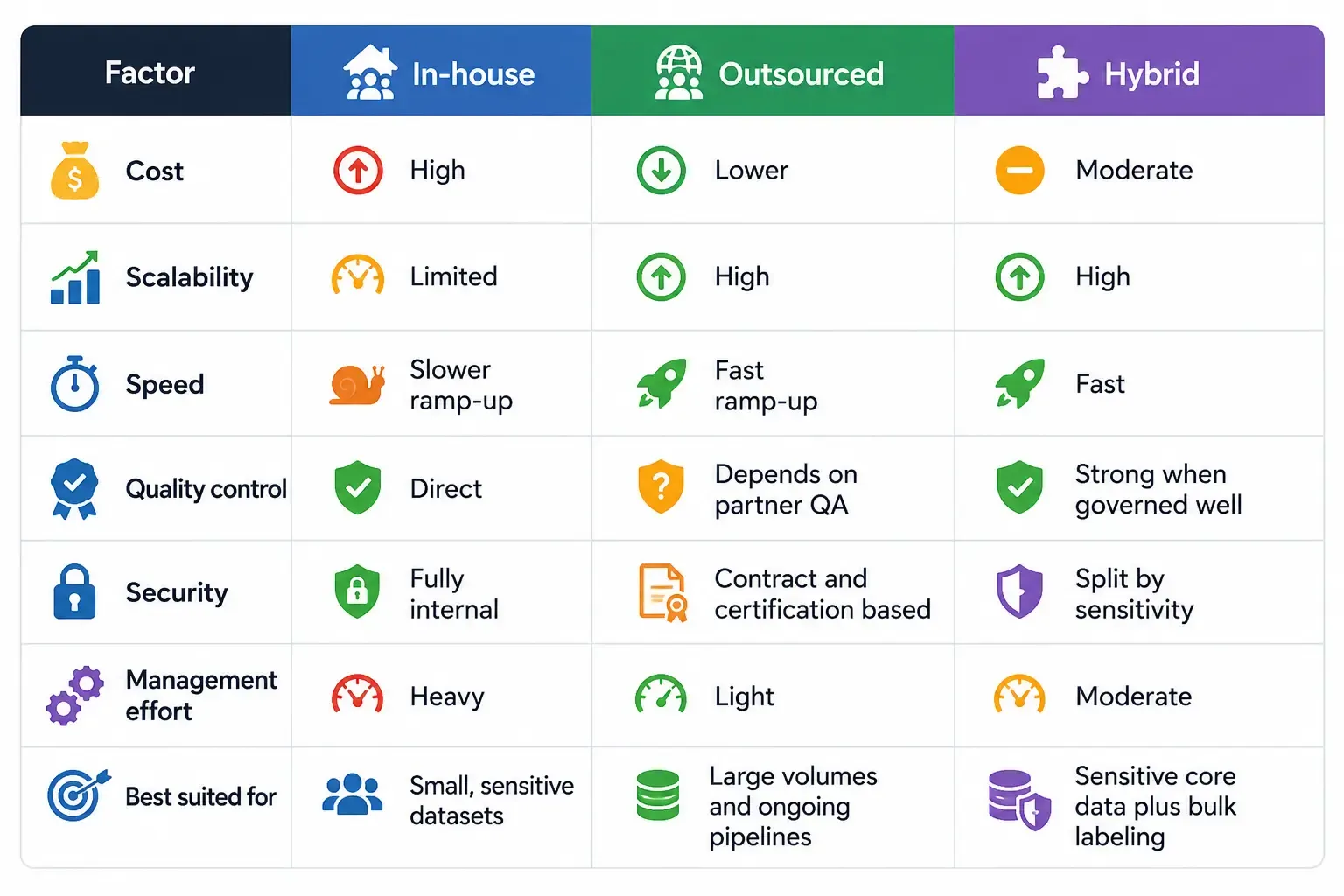
Many established AI teams end up choosing a hybrid where they have domain experts on their own staff who deal with edge cases and validation of their results, and then a partner performs the bulk of the work.
Security and Compliance
The information in training data can be personal, medical, or related to commercial interests. Prior to sharing a single file, verify the following:
GDPR alignment for any dataset involving individuals in the EU
ISO 27001 certification as evidence of an audited information security management system
SOC 2 controls, where applicable to your industry
Signed NDAs covering the company and every individual annotator
Role-based access control so that annotators only see data that they need to see.
In-transit and on-disk encryption
The rules to be followed when handling PII information, such as redaction, masking, and documented deletion.
Ask for evidence, not assurances. A serious partner will share certificates and policy documentation without hesitation. Logictive Solutions, for example, operates under ISO/IEC 27001:2022 certification with documented access control and secure delivery workflows.
How to Choose an Annotation Partner
By this stage, the technical questions are settled, and the commercial ones begin. Ask any prospective vendor:
Can they scale? How quickly can they add trained annotators when volume triples?
What is the QA process? Ask for the specific structure: review layers, sampling rate, and how accuracy is measured.
Do they have domain expertise? Medical imaging, insurance documents, and agricultural imagery each require different judgment.
How is security handled? Certifications, NDAs, and access controls should be documented.
Will they run a pilot? A partner confident in their work will agree to a paid pilot.
How is pricing structured? Per object, per image, or per hour, and what happens with revisions.
What is a realistic turnaround? Timelines should be driven by task complexity, not just dataset size.
This is also where geography becomes a practical decision. A data annotation company in Nepal provides a network of trained annotators not only at more affordable prices but also with a strong overlap in working hours, allowing US/UK/European teams to use a night of labor to get a job done, then review the results in the morning.
Run a Pilot Before Scaling
Never commit a full dataset to an untested partner. Start with 1,000 to 5,000 samples and measure four things:
Accuracy against your gold standard set
Turnaround time versus the estimate given
Communication quality when edge cases surface
Revision rate after the first QA round
If the pilot holds up on all four, scale with confidence. If it does not, you have lost a week instead of a quarter.
Conclusion
The logic is simple, and it holds at every scale. Good labels produce good training data. Good training data produces better AI. Better AI produces better business outcomes. Teams that treat labeling as a throwaway task pay for it later in model performance, and teams that treat it as engineering work get compounding returns.
Looking for a reliable data annotation partner? Whether you are building computer vision, NLP, or multimodal AI models, starting with a small pilot is the best way to evaluate quality, turnaround time, and collaboration before scaling your dataset.
Frequently Asked Questions
What is data annotation? It is the process of labeling raw images, text, audio, or video so that machine learning models can learn to recognize patterns and make predictions.
Why is it important? Model accuracy is capped by label quality. Inconsistent or incorrect labels lead directly to poor precision, weak recall, and biased predictions.
What are the main types? Computer vision (bounding boxes, polygons, segmentation, keypoints, cuboids, OCR), NLP (classification, NER, sentiment, intent, POS tagging), and audio (transcription, diarization, event detection).
Which annotation tool is best? There is no single best tool. CVAT and Label Studio suit open-source workflows, while Labelbox, Encord, and SuperAnnotate suit enterprise teams needing automation and governance.
How much does it cost? Pricing depends on complexity rather than volume alone. Bounding boxes are inexpensive per unit, while instance segmentation and 3D cuboids take significantly longer per item.
Should I outsource labeling? Outsource when volume is high, timelines are tight, or your internal team should be building models rather than labeling data. Keep highly sensitive or expert-dependent work in house or in a hybrid setup.
Which industries use it most? Healthcare, insurance, autonomous vehicles, agriculture, retail, manufacturing, and geospatial analysis.
How do you ensure quality? Clear guidelines, annotator training, gold standard benchmarking, consensus review, inter-annotator agreement tracking, and continuous QA sampling.