Casestudy

Data Annotation Team for Fetal Anatomy - Fetal Ultrasound AI Annotation

The primary aim was to assist DeepEcho in creating a trusted AI model by providing high-quality annotated fetal ultrasound images. These annotations had to be of high medical and regulatory standards to be able to help with FDA approval.

Target Platform:
Web
Fetal Ultrasound AI

Outcome Framework

Services We Provided

01
Image Segmentation Annotation
02
Image View Classification
03
Tool CVAT Annotation
04
Quality Assurance & Review

Who is DeepEcho?

DeepEcho is a health technology company that uses artificial intelligence and deep learning to improve prenatal and maternal healthcare. Simply put, they create software that can help physicians and radiologists read fetal ultrasound images more quickly, more intelligently, and more precisely. They have a platform that automatically quantifies key fetal anatomical structures during ultrasound scans and helps clinicians make more accurate diagnoses. The idea is to minimise birth defects, diagnose problems such as preterm birth in their early stages and to also enhance the outcomes of both the mother and the baby. They required thousands of correctly labelled ultrasound images to train their AI to identify these anatomical structures, and that is precisely what Logictive Solutions was able to provide. Contribution: Rural area of Morocco where there is a radiologist.

Screenshot 2026-04-15 at 12.19.32 PM.png

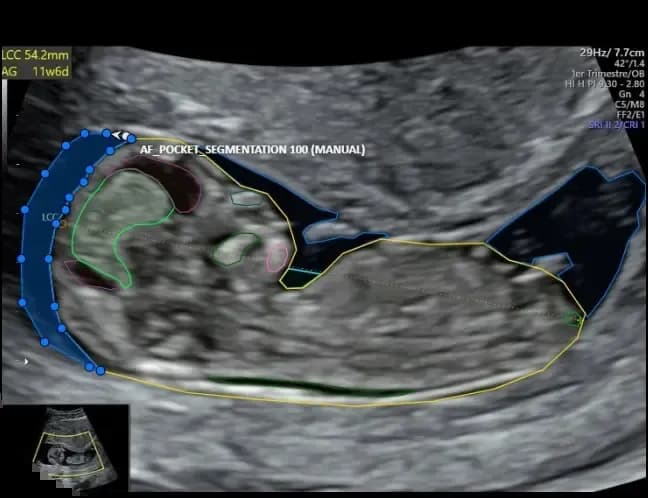
Image Segmentation

We carefully drew outlines around specific anatomical structures inside each ultrasound image — like the spine, heart, lungs, brain ventricles, and placenta. This tells the AI exactly where each body part is located in the image. Precision here is critical — even small errors can affect how the AI diagnoses later.

Image View Classification

We also labelled each ultrasound image based on the type of scan view it represents — for example, whether the scan shows a head view, abdominal view, or limb view. This helps the AI understand the context of each image before analysing it.

A Small but Focused Team

A total of 4 people worked on this project - a lean team built for precision and quality rather than volume.

Project Lead

Oversaw the entire annotation workflow, maintained quality standards, communicated with the DeepEcho team, and ensured deadlines were consistently met without compromising accuracy.

Data Annotators

Performed hands-on annotation of fetal ultrasound images — drawing segmentation masks and classifying image views — using CVAT with careful attention to anatomical accuracy.

FDA Clearance — The Biggest Win

The most significant outcome of this project was DeepEcho receiving FDA 510(k) clearance. Here is what that means in plain terms:

DeepEcho Received FDA 510(k) Clearance

The U.S. Food and Drug Administration (FDA) reviewed and approved DeepEcho's fetal ultrasound AI platform. This is one of the most important regulatory approvals a medical AI product can receive — it means the platform is officially recognised as safe and effective for clinical use in the United States. For AI models to receive this level of approval, the training data — including the annotation work — must meet extremely high standards of accuracy and consistency. Our team's annotations directly contributed to making this possible.

What We Used to Get the Job Done

Each tool played a specific role in keeping the project running smoothly — from annotation work to team communication.

The challenge

Learning a New Tool

No prior experience with CVAT at the start. Had to learn advanced features like track labels and label hierarchies. Required time and practice before reaching full efficiency. Delivering the medical data with no medical expertise.

Anatomical Complexity

Fetal structures are small, overlapping, and hard to distinguish Some regions are barely visible in ultrasound images The team had to memorise many different segmentation regions and labels

Inconsistent Image Quality

Not all ultrasound images were clear or high-resolution Some frames had poor contrast or unclear anatomy Required careful judgment on ambiguous images

Operational Pressure

Tight delivery timelines while maintaining high accuracy Repetitive work requiring sustained focus over long hours

How we Handle them

Hands-On Tool Training

The team dedicated time to learning CVAT thoroughly before production began. We practised with sample data, asked clarifying questions, and built internal guides to speed up the learning curve. Proper SOP with proper collaboration with the client, and multiple feedback with the client

Regular Client Sessions

We held frequent check-ins with DeepEcho to review annotations, get anatomical guidance, and clarify ambiguous cases — ensuring we were always aligned with their clinical expectations.

Quality Review Process

The Project Lead performed ongoing quality checks on all annotations before delivery. This caught errors early and maintained consistently high accuracy standards across the board.

Team Communication & Support

Open Slack channels allowed the team to quickly discuss tricky images, share best practices, and raise flags, preventing bottlenecks and keeping everyone on the same page.

Precision Annotation That Helped Change Prenatal Care

This is one of the most significant works that Logictive Solutions has provided. Our team directly trained an AI system to produce high-quality annotations of fetal anatomy, which is now FDA-approved and is in use to support prenatal care for doctors. It demonstrated that a small, motivated team, properly trained, with the right tools, and determined to do it right, can truly change things in an experienced and high-stakes industry such as medical AI. The FDA 510(k) clearance DeepEcho has obtained is a reflection of the accuracy and consistency of the work provided. In the case of Logictive Solutions, this engagement establishes an unambiguous standard of what can be accomplished in the field of medical data annotation - and it shows that we can assist health technology firms in developing AI that really changes lives.