Casestudy

Deeparts Bounding Box Annotation Project

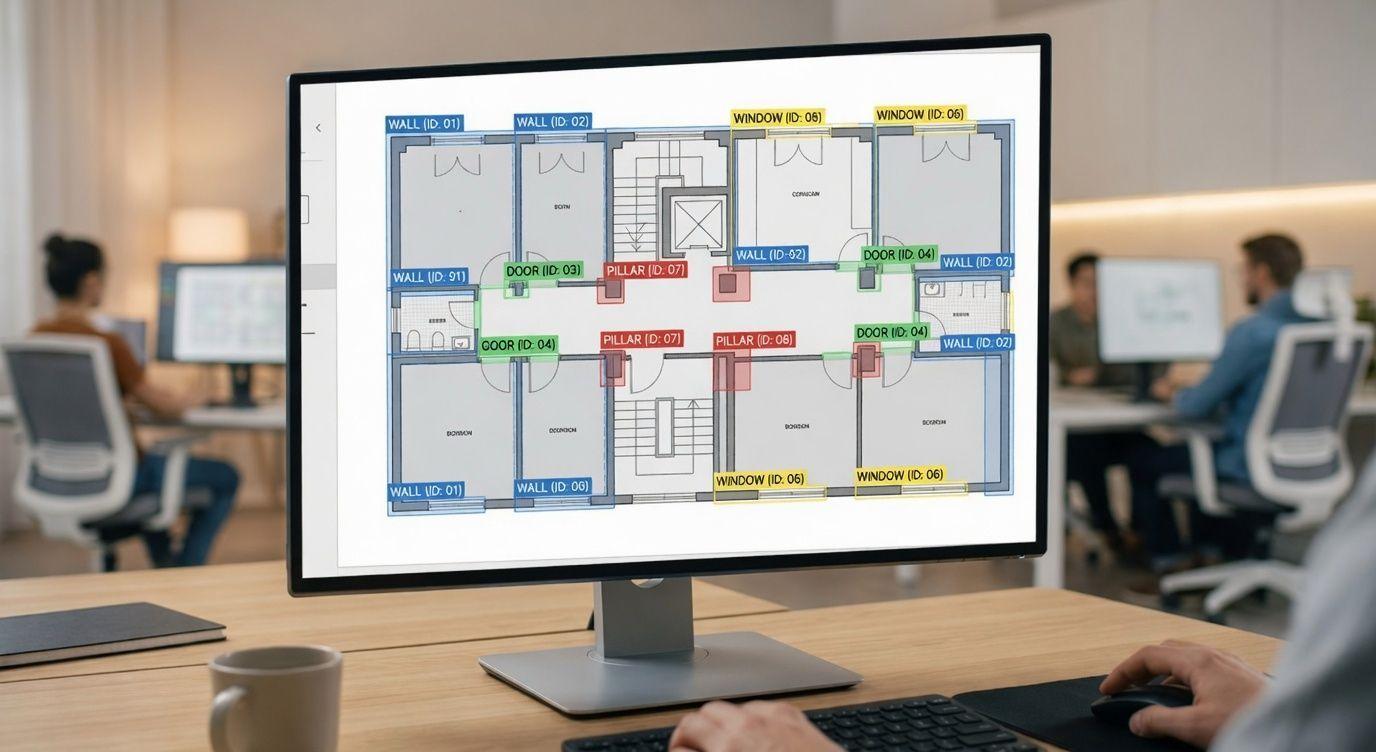
Bounding box annotation project. To explain in simple terms, Logictive Solutions are provided with floorplans for buildings where we need to distinguish and annotate walls, pillars, doors, windows. Looking from a non-engineering background individual, this project still looks potential as it might help in the construction working process or to determine the internal structure of the building.

Target Platform:
Web
Bounding Box

Outcome Framework

Services We Provided

01
AI Tracking System
02
Data Management

Project Overview

This project focused on training an AI model for floorplan labeling by identifying and annotating key architectural elements within floorplan images. The primary objective was to accurately detect and label four structural components—windows, doors, pillars, and walls—ensuring consistency and precision across the dataset. The annotation process was carried out using CVAT as the primary tool, enabling efficient and standardized labeling workflows. A team of annotators worked collaboratively on the project, with quality assurance specialists assigned as needed to maintain accuracy, validate outputs, and ensure adherence to project guidelines.

fetal-verify.png

Approach and Process: Four Steps

The team project work approach involved four main steps

Uploading Task

Uploading the annotation task on CVAT. QA is responsible for uploading tasks on CVAT. QA needs to update the task on progress reports.

Annotation

Annotation of the required architectural elements.All regular team members need to work on their respective tasks according to the progress report.

QA Check

Quality Assurance check of the completed annotations. QA is responsible to maintain quality and provide feedback when necessary. QA needs to hold the task (If working on the task itself) and switch to QA when a team member completes a task.

Uploading Outcome

Uploading the final outcome to the client's database. QA needs to verify if the progress report shows daily progress and is updated. QA needs to calculate the remaining task with their respective number of floorplans completed and added annotation and create a report accordingly.

Initial Challenges Faced

Issues or obstacles that occurred during the project's initial stages.

Lack of Clarity

As the work continued, different instances were found that needed clients clarification. (Very first)

Meeting Deadline

There was no clarity on how much annotation is needed in a single task resulting in expecting the task to be complete sooner than expected. This resulted in missing deadlines in the initial stages of the project.

Tools Lagging

Low device performance capacity and low internet bandwidth caused the annotation tools to lag.

Challenge Mitigation Strategies

To improve workflow efficiency and reduce ambiguity, a structured Q&A document was introduced, allowing team members to log newly encountered instances in floorplans for client clarification. This streamlined communication and ensured consistent annotation standards across the project. As the work progressed, the team also implemented a data-driven approach to planning by analyzing previously completed batches and calculating annotation ratios relative to the number of floorplans. This method significantly improved estimation accuracy and helped set more realistic and achievable deadlines. In addition to process improvements, technical upgrades were made by enhancing bandwidth connectivity and upgrading laptops, which collectively boosted overall performance and productivity.

bounding-qna.png

Project Outcomes and Results

A total of 100 floorplans were successfully annotated as per the project requirements, ensuring complete coverage and consistency across all tasks. Following the implementation of effective mitigation strategies, the team was able to meet the final deadlines without delays, demonstrating improved planning, coordination, and execution.

Lessons Learned: Communication and Training

As the task had different use cases, open communication and proper training is essential.

Open Communication

Crucial for handling different use cases and ensuring consistency in annotation.

Proper Training

Necessary to prepare the team for the variety of instances found in the floorplans.

Future Improvements and Operational Efficiency

Upgraded device and Bandwidth

As the tool starts lagging with increasing annotation, having better laptop and internet bandwidth was necessary to overcome/reduce tool lagging.

Tasks assigned according to task size and device performance

Since bigger files were the one that lagged the most, those tasks were assigned to the one with the better device to reduce lagging and have better throughput.

Break Frames for High Annotation Tasks

If there are multiple high annotation tasks, it will be better to break frames so multiple people can work separately with reduced possibility of lagging.

Include Extra Time on Deadline

It is better to include extra time on deadline as the deadline mostly did not meet due to the unpredictable nature of the task.