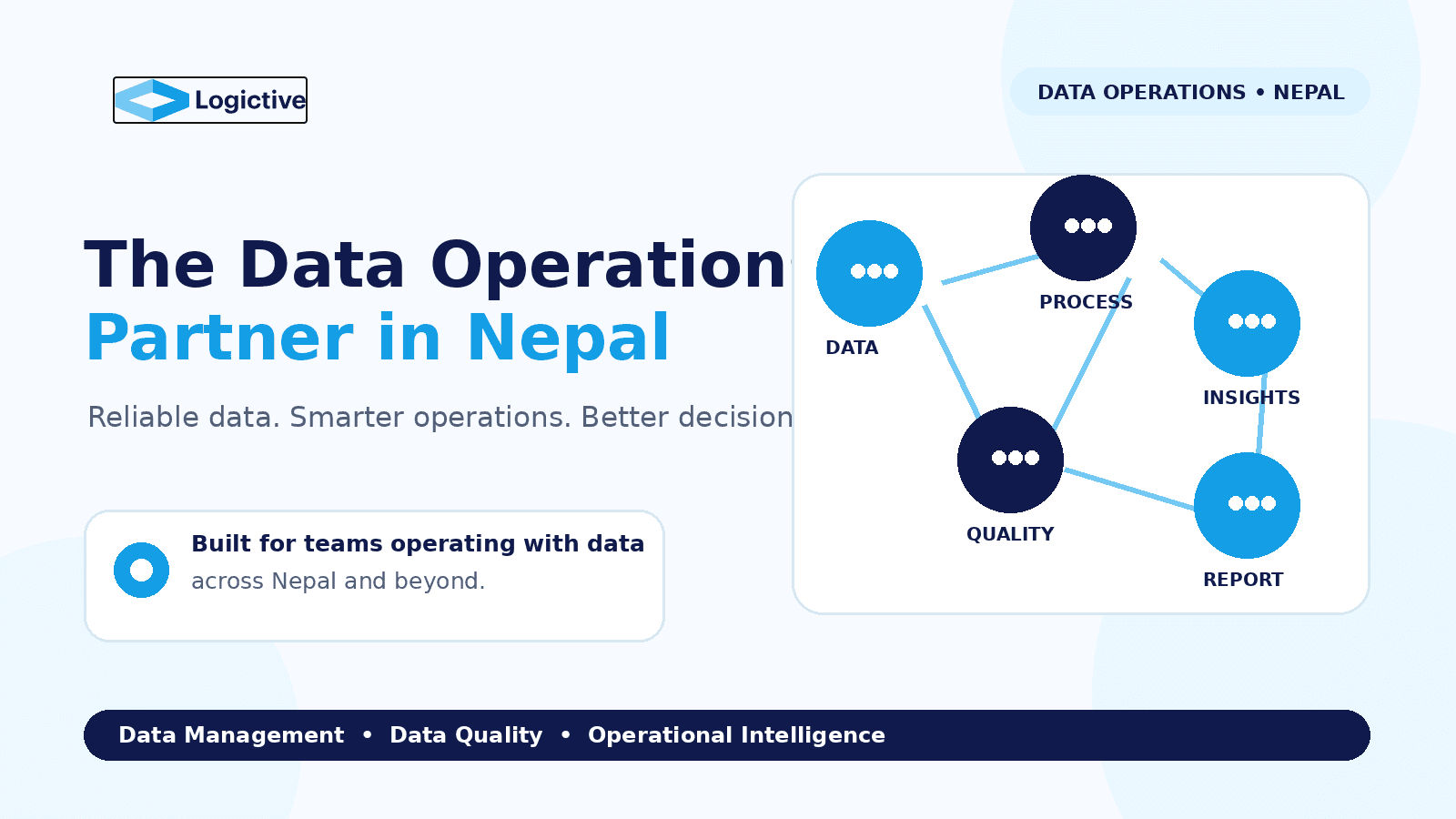
Every AI project eventually faces the same challenge: the technology is ready, but the data is not. It may be unlabeled, unstructured, or trapped in old systems that are difficult to manage. At this stage, the real challenge is not just building the right AI model but finding the right team to prepare and manage the data behind it.
That is where a company like Logictive Solutions, as a **data operations partner, **can help. Unlike freelancers or one-time vendors, a data operations partner in Nepal provides a dedicated team with the skills, processes, quality checks, and experience needed to manage data at scale.
Today, more global companies, from AI startups in San Francisco to insurance companies in the UK, are looking to Nepal for these services. Kathmandu-based companies like Logictive Solutions are building strong expertise in data annotation, data management, and other data operations.
In this article, we’ll explain what a data operations partner in Nepal does, why Nepal is becoming a practical choice for data operations, why Logictive Solutions is the right data operations partner, and what you should look for when choosing a reliable team.
What a Data Operations Partner in Nepal Actually Does
The term gets used loosely, so it is worth being precise. A data operations partner is responsible for the data pipeline work that sits between raw input and production-ready output. That typically falls into two connected categories.
Data annotation involves providing labels for data to enable machine learning models to learn from them. This includes object detection in images, sentiment and intent classification in text, transcription and sentiment classification in speech, and scene understanding of video frames. Without accurate labels, a model cannot learn accurately. As the saying goes in ML circles, garbage in, garbage out.
Data management is more comprehensive than a data mart, which involves extracting, cleansing, structuring, validating, and migrating data for its use in the production system. For businesses dealing with lengthy legacy setups, the insurance market transferring decades of policy records, or any business that has had inconsistencies within their data over time.
When performed with finesse, the two disciplines complement each other. A team that understands data quality at the annotation level also understands what clean, structured data looks like at the systems level.
Why Nepal Has Become a Practical Choice for Data Operations
Nepal is not the most obvious location when you think of data outsourcing. But for teams that have actually worked with companies there, the practical case is clear.
Talent: Kathmandu IT and computer science programs have produced a growing pool of technically trained graduates who adapt quickly to structured annotation workflows, QA processes, and domain-specific labeling tasks. The workforce is young, detail-oriented, and genuinely invested in getting the work right.
English proficiency: Communication friction is one of the most underrated costs in outsourcing. Nepal English-proficient workforce means that briefings, QA feedback, and project updates do not get lost in translation.
Cost efficiency: Delivery costs are competitive with other South Asian outsourcing markets and significantly lower than Western equivalents, without the quality penalty that sometimes comes with the cheapest option.
Time zone coverage: Nepal's time zone is UTC+5:45, making it convenient for employees who work different shifts since they overlap with the European morning and the US afternoon. Nepal is a good fit for teams looking for follow-the-sun operations or for those teams who want someone up and at work while the headquarters is resting.
None of that creates quality on its own. Process discipline does. The difference between a genuine data annotation company in Nepal and a vendor that just has lower hourly rates is the QA infrastructure built around the labeling work.
What does Logictive Solutions provide as a data operations partner in Nepal?
Logictive Solutions is headquartered in Kathmandu and operates primarily as a data operations partner for international clients across the US, UK, and beyond. The team also supports national organizations, but the core of the practice is built around the demands of global AI and enterprise projects, which tend to be less forgiving of quality lapses.
The work spans two primary service areas.
Computer Vision Annotation
For AI teams building perception systems, Logictive handles the full range of computer vision annotation: bounding boxes, polygon segmentation, keypoint labeling, and semantic segmentation. These are the labels that help models learn to identify objects, estimate human pose, understand scenes, and detect abnormalities.
Use cases range from autonomous vehicles (where a wrongly labeled pedestrian can have real-world impact), agri-tech crop monitoring, solar panel detection, and retail shelf analysis. Each use case requires annotators who understand what they are labeling and why it matters, rather than someone just clicking through photos, for each use case.
Natural Language Processing
On the NLP side, the team works on named entity recognition (NER), sentiment analysis, intent classification, and audio transcription. These are the labels that power search, chatbots, customer support automation, and any language-driven AI system.
CVAT, Labelbox, V7 Darwin, Supervisely, Dataloop, and Datasaur.ai are the annotation tools used. The team will fit into any pipeline that a client has, rather than requiring clients to change tools mid-project.
Data Management and Migration
Beyond annotation, Logictive provides data management services that cover the full data lifecycle: extraction from unstructured or legacy sources, cleaning and normalization, validation before data enters production systems, and large-scale migration projects.
The insurance vertical is a particular area of depth. Migrating decades of policy records, claims data, and financial history requires zero data loss and audit-ready documentation at every stage. That is a different discipline from general data entry and one that Logictive has built specific workflows around.
What the Quality Process Actually Looks Like
The quality assurance structure is what separates a dependable data annotation service in Nepal from one that delivers inconsistent results at scale. At Logictive, that structure includes the following:
- Multi-layer review at every annotation stage, not a single spot check at the end
- Human-in-the-loop validation that pairs trained annotators with structured QA passes
- Domain-specific onboarding for sensitive categories, including medical imaging, where labeling errors carry direct downstream consequences
- A control strategy that scales from a small pilot batch to a large, high-volume program without changing the QA approach or methodology.
This is supported by ISO/IEC 27001:2022 certification, giving international clients the confidence to know the information security practices before sharing sensitive data. That certification is critical for healthcare, insurance, and fintech projects in particular.
Industries Logictive Solutions Works With
The data annotation and management work spans a range of sectors, each with its own labeling requirements and compliance considerations:
- Insurance Tech: policy and claims data migration, document processing
- Finance Tech: financial record structuring and validation
- Autonomous Vehicles: high-accuracy bounding box and segmentation annotation
- Health Tech: medical image labeling with domain-trained annotators
- AgTech: crop detection, field analysis, and yield monitoring datasets
- Retail and E-commerce: product image annotation and catalog data structuring
- Geospatial: satellite and aerial image analysis
How a Project Gets Started
Logictive runs projects through a five-step engagement model designed to reduce the friction of getting a new data initiative off the ground:
- **Discover and Assess: **Define the business goal and suggest what annotations and/or data management solution is appropriate for this use case.
- Plan and Kick Off: Defining a project roadmap and aligning on timelines before work begins
- Build and Train: Preparing the annotation or data team and configuring workflows to match the project's requirements
- Deliver and Validate: Continuous QA on every batch, not just final delivery
- Optimize and Scale: Refining the process and adjusting team size as volume grows
This structure works for both one-time projects and ongoing data operations programs. The intent is to function as an extension of the client's team rather than an external vendor that needs constant management.
How to Choose the Right Data Operations Partner?
If you are evaluating options, the questions worth asking go beyond price per hour:
- Does the team run multi-layer QA or just a final review pass?
- Do they have experience in your specific domain, such as medical, insurance, or autonomous systems?
- Can they work with the annotation tools you already use?
- Do they have verifiable information security certifications for handling your data?
- Can the team scale without the quality process breaking down?
The answers tell you whether you are looking at a real data operations partner in Nepal or a lower-cost body shop.
Talk to a data operations team that has done this before.
If your team needs a data annotation company in Nepal that treats quality assurance as the core of the service or a data management company in Nepal that can take on a full migration project, get in touch with Logictive Solutions or book a meeting to talk through your data requirements. The conversation starts with your use case, not a sales pitch.
Frequently Ask Questions
Q: What does a data operation partner in Nepal do?
A data operation partner handles the annotation, cleaning, structuring, and validation work that sits behind AI models and enterprise data systems, combining trained human expertise with structured QA workflows
Q: Is a data annotation company in Nepal a good fit for AI and ML projects?
Yes, provided the company runs structured QA and works with the annotation tools your pipeline already uses. Logictive Solutions supports computer vision and NLP annotation with multi-layer validation built into every batch.
Q: Does Logictive Solutions handle data management as well as annotation?
Yes. Alongside annotation services, Logictive provides data management and migration services, including large-scale insurance data migration designed for zero data loss and full audit compliance.
Q: What industries does Logictive Solutions work with?
Insurance Tech, Finance Tech, Autonomous Vehicles, Health Tech, Agri Tech, Retail and E-commerce, and Geospatial, supporting clients in the US, UK, and Nepal from its Kathmandu office.
Q: How does outsourced data annotation in Nepal compare to other locations?
Nepal offers a technically trained, English-proficient workforce, competitive costs, and a time zone that works well for US and UK teams. The differentiating factor is always process quality, which varies significantly between providers.