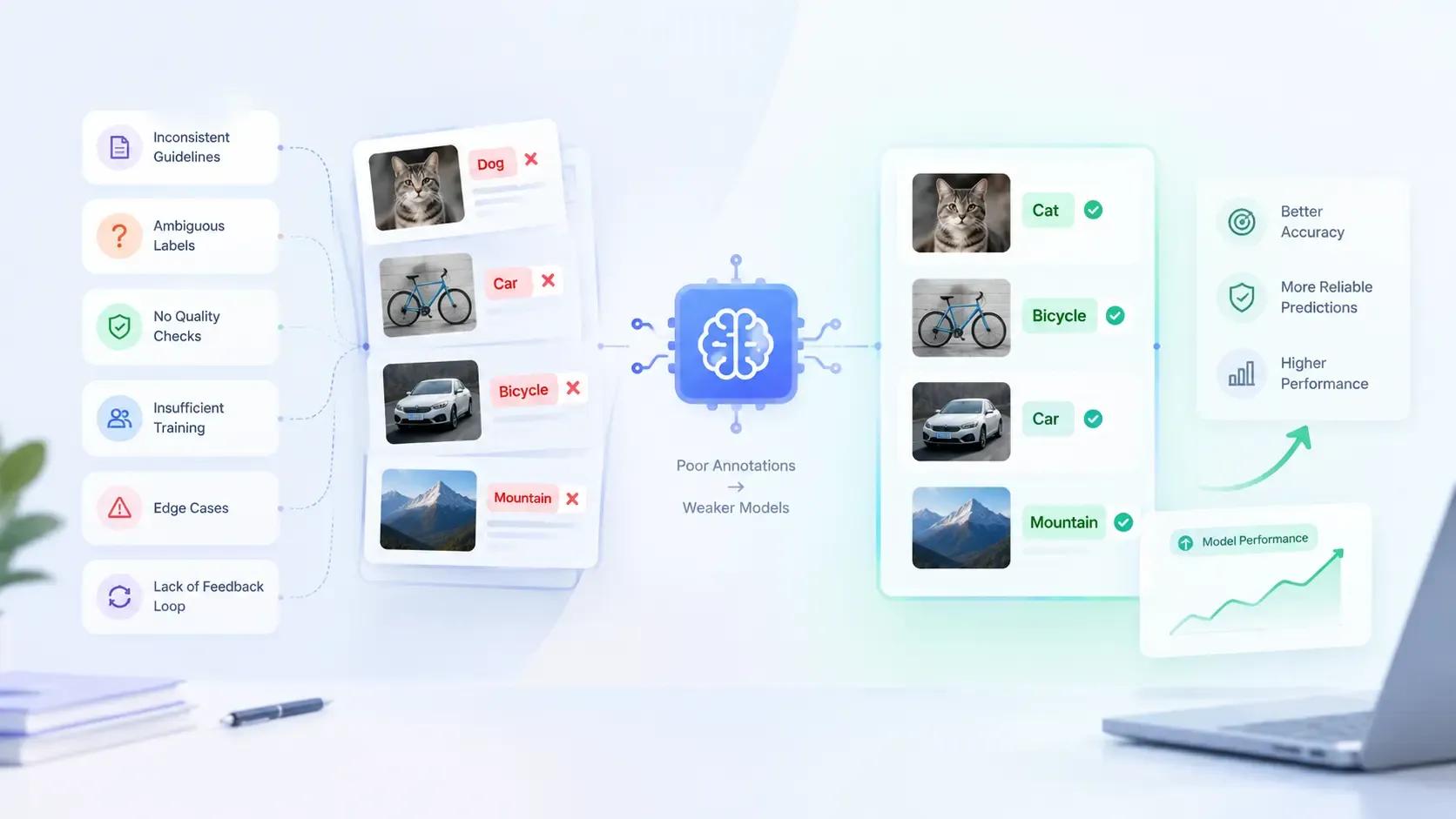
Imagine your machine learning model performs well during testing, but once it goes live, it starts missing things that people can easily recognize. You test the model again, adjust the algorithms, fine-tune the parameters, and even add more computing power. Yet, the results barely improve.
The problem might not be the model itself. It could be the data used to train it.
Even a small number of incorrect labels can teach a model the wrong patterns. These mistakes often go unnoticed during development but can lead to poor predictions and unreliable results in real-world situations.
In this article, we’ll explore seven common data annotation mistakes that can affect machine learning performance, explain how to fix them, and show how catching these issues early can save your team time, effort, and money.
Why Small Labeling Errors Have a Big Impact on Model Performance
A model treats labels as ground truth. It does not know a label is wrong. It simply learns whatever pattern the labels suggest, including the mistaken ones.
That is why the impact of annotation errors on model performance goes beyond a small dip in accuracy. Errors can bias predictions, make results unstable between training runs, and lower the model’s confidence even when it is right.
The research keeps pointing the same way. In 2021, Northcutt, Athalye, and Mueller found that an average of 3.4% of examples across ten commonly used datasets were mislabeled, and the harm grew with model size. QuickDraw was the worst case, with 10.1% of its data labeled incorrectly.
Newer work shows the problem has not gone away. At EMNLP 2025, Nahum and colleagues found a substantial number of label errors in existing benchmarks, and correcting them raised reported model performance significantly. Many supposed model mistakes were really labeling mistakes. Their methods for handling bad labels during training also improved fine-tuned models by up to 4%. Around the same time, MIT researchers revised examples from fifteen popular benchmarks and showed that pervasive label errors can hide real model failures.
The stakes are higher in healthcare. A 2024 study of diabetic retinopathy screening concluded that even a small percentage of label errors in human image grading can significantly affect how a deep learning model’s performance is measured in real-world use.
Example: Say a retail team labels 50,000 product photos and 5% are wrong. That is 2,500 bad examples. If most of them fall into one confusing category, such as damaged versus defective items, the model learns that confusion as a rule. Fixing it later means finding those labels, relabeling them, and retraining. Preventing it would have required a clearer guideline.
The 7 Most Common Data Annotation Mistakes
1. Inconsistent Annotation Guidelines
When data annotation guidelines are unclear or change without proper documentation, different annotators may assign different labels to similar examples. Even experienced annotators can disagree when class definitions or decision rules leave room for interpretation.
These inconsistencies introduce noise into the training dataset, making it harder for a machine learning model to learn reliable patterns.
Fix: Create a version-controlled annotation guideline with clear class definitions, positive and negative examples, and documented changes. When guidelines change, review previously labeled data to determine whether relabeling is necessary.
2. Ambiguous Labels and Overlapping Classes
Consider a project in which the classes of “damaged” and “defective” are considered for a warehouse inspection. Either of the worked-out boxes would fit into a slightly dented box. Annotators are left with unwarranted uncertainty.
If a category overlaps, the model cannot distinguish between the categories. The accuracy decreases on just those classes.
Fix: provide rules for inclusions/exclusions for each class and examples of borderline cases (written and/or visually). When two classes cannot be differentiated reliably, be sure to redefine or combine the classes before starting labeling.
3. No Quality Assurance or Inter-Annotator Agreement Checks
Many teams focus on completing annotation tasks on time but overlook the importance of checking label quality. Without regular quality checks, it is difficult to know whether annotators are labeling data consistently.
As a result, mistakes may go unnoticed until the model starts underperforming, when reviewing thousands of labels can become time-consuming and expensive.
Fix: Use multiple layers of quality checks and measure inter-annotator agreement (e.g., Cohen’s kappa) to see how consistently annotators label the same data. A low agreement score may indicate unclear guidelines, different interpretations, or inconsistent labeling practices. However, agreement scores alone cannot guarantee label quality. Regular reviews against verified examples can help identify mistakes and improve consistency. For more information, read our post on detecting label noise.
4. Skipping Annotator Training and Calibration
New annotators typically begin with a document and a time frame. They all create a slightly different mental model of what to do.
Next, there is variation, and that is either across people or across batches, and it is difficult to track back.
Fix: Perform a small pilot batch first. Discuss the outcomes as a group, communicate about any differences of opinion, and revise guidelines accordingly. Recalibrate briefly whenever the team or task changes and provide regular feedback to annotators on their individual levels of accuracy.
5. Ignoring Edge Cases and Class Imbalance
Rare cases are often overlooked or incorrectly labeled during data annotation. However, these examples can be critical in applications such as product defect detection, fraud detection, and medical image analysis.
When a dataset contains too few examples of certain classes, a machine learning model may struggle to recognize them reliably. This can lead to poor performance on rare but important cases, even when the model performs well on more common examples.
Fix: Maintain a shared log of edge cases for annotators and reviewers. Review class distribution before training and collect or annotate additional examples of underrepresented classes where possible.
6. Using Non-Expert Annotators for Domain-Specific Data
Legal documents, medical images, and technical documents require domain knowledge. They can be confidently tagged by a general annotator but still be incorrect.
These errors in labeling data are the most difficult to detect, as the labels appear finished and credible. Even a reviewer who is not knowledgeable in the topic can sign them off.
Fix: Use domain-trained annotators and expert review for domain-specific data. The expert doesn't have to name each of these things. Focussed review of samples and areas for doubt may be sufficient. If considering the team builds versus outside support, we've compared the in-house and outsourced annotation options here and detailed the trade-offs.
7. No Feedback Loop Between Model Errors and Labeling
There are many teams that see labeling as a static situation. Labels are applied to the data, the model is fine-tuned, and no one pays attention after.
Model errors can reveal problems in the training data. For example, if a machine learning model repeatedly confuses two categories, the annotation guidelines may be unclear, the classes may overlap, or some training examples may be mislabeled.
Without a feedback loop, these problems can persist across training cycles. Changes in real-world data can also introduce data drift, making the training data less representative of current conditions.
Fix: Regularly analyze incorrect model predictions to identify potential labeling issues. Update annotation guidelines when necessary, correct affected labels, and retrain the model when appropriate.
What These Mistakes Really Cost Your Team
The cost of data labeling errors rarely appears as one line item. It is spread across several places:
- Relabeling effort: annotator and reviewer hours spent redoing finished work.
- Retraining compute: every new training run uses time and money.
- Engineer time: data scientists debug the model when the data is the issue.
- Delayed releases: a feature that was meant to ship this quarter slips to the next.
The pattern is simple: the later an error is found, the more it costs. That is the heart of data labeling ROI. Money spent on clear guidelines, training, and QA is small compared to the cost of fixing a flawed dataset after the fact. For a full breakdown, read our pillar post on the cost of data labeling errors.
Quick Checklist to Avoid Common Labeling Errors
Copy this list into your project plan:
- Guidelines are written, versioned, and full of examples
- Classes are clearly defined and do not overlap
- QA and agreement scoring are in place
- Annotators are trained and calibrated
- Edge cases are tracked in a shared log
- Domain experts review specialized data
- Model errors feed back into labeling
Want a deeper version? Our annotation QA checklist expands each point into concrete steps. contact us now
Conclusion
Most data annotation mistakes are preventable. Clear guidelines, trained annotators, steady QA, and a feedback loop from model errors will catch the majority of them before they reach production.
Every hour spent on these basics protects your budget, your timeline, and your model’s reliability. If you are reviewing an existing dataset or planning a new one, start with the checklist above and run a small pilot first.
If you would like a second pair of eyes on your process, the Logictive Solutions team is happy to talk through your project. You can also learn more about our data annotation services.